However, linking verbs don't express action. Instead of acting, they describe and connect. Specifically, this type of verb describes a state of being. Moreover, it connects the subject of a sentence with the subject complements. Subject complements are predicate nouns or predicate adjectives.

"To be," "to become," and "to seem" are always linking verbs. Words that can function as a linking or an action verb include smell, appear, look, and sound. Linking verbs are followed by adjectives which are subject complements. Action verbs are followed by adverbs, which are their modifiers. Verbs that can be used as either linking verbs or action verbs includefeel,get,grow,look,prove,remain,smell,sound,stay,taste, andturn. Adverbs modify action verbs, not linking verbs.

Using adverbs instead of adjectives with linking verbs will result in incorrect sentences, as shown here. Remember regular verbs are followed by adverbs, and linking verbs are followed by adjectives. Some common linking verbs areappear,seem,smell,sound, andtaste. Linking verbs are verbs that connect the subject of the sentence to adjectives or nouns that describe it. They are words that show the state of being. The most common linking verbs are the "be" verbs.
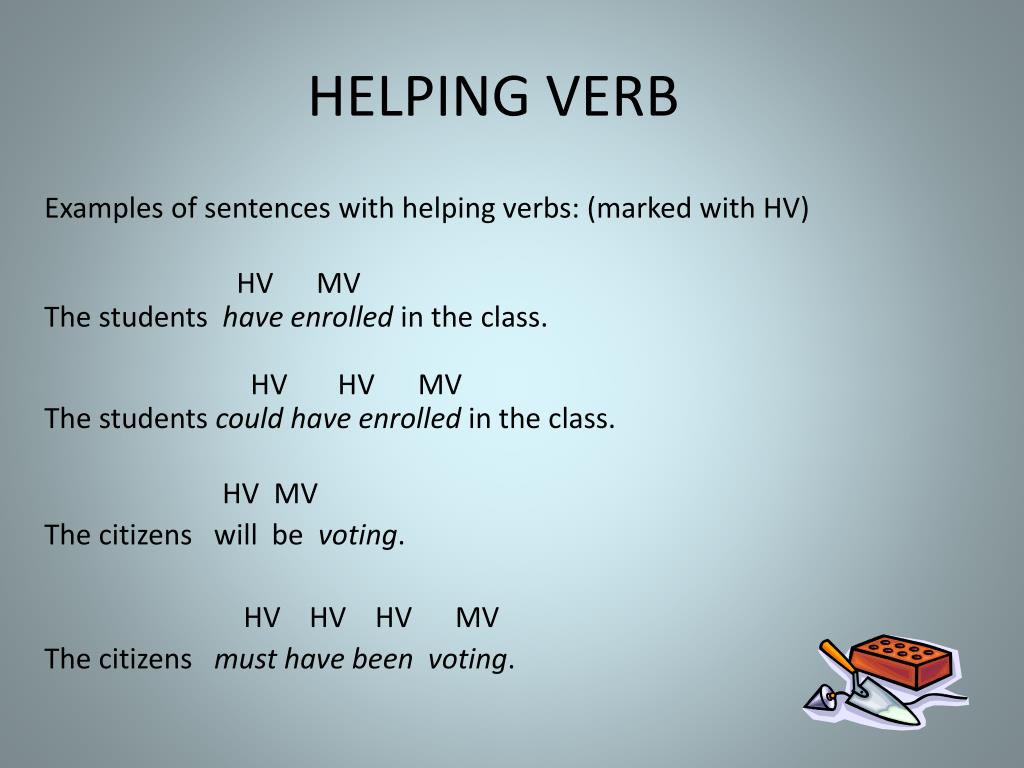
Please refer to "be" verbs to learn how to use "am", "is", "are". In both cases, the main verbs are the action verbs —rewriting and editing, respectively — and the forms of to be simply act as helping verbs. (An industrious bunch!) These sentences do not contain linking verbs and are therefore not relevant for this discussion. It connects the subject of the sentence with a subject complement such as a predicate nominative or predicate adjective. The subject complement renames or describes the subject.

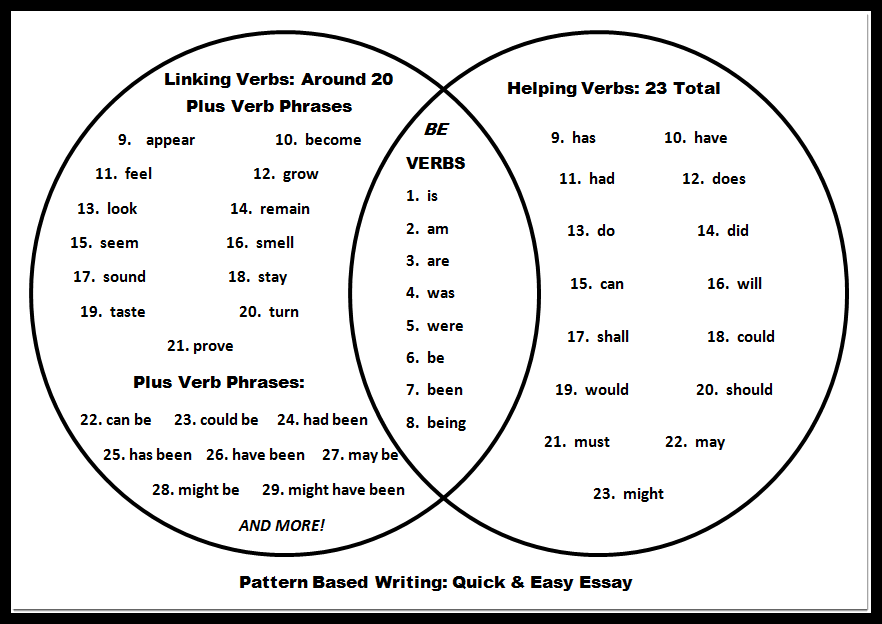
To see if a verb is a linking verb, try replacing it with ''equals.'' If the meaning of the sentence remains the same, the verb is a linking verb. The main difference between linking and helping verbs is that linking verbs act as the main verb of a sentence whereas helping verbs do not act as the main verb. In addition, helping verbs are generally used with action verbs whereas linking verbs do not denote an action.

Aside from that, linking verbs allow changing of positions between the subject and the subject complement. Unlike active verbs however, linking verbs do not alter the meaning of the sentence. In today's lesson we will learn about linking verbs. It just links, or joins, the subject of a sentence to a word that identifies or describes the subject, also called the subject complement. Linking verbs, also called copulas or copula verbs, connect the subject of a sentence with an adjective, noun, or descriptive phrase.
To distinguish a copula verb remember that they do not indicate action in a sentence. Rather they describe a state of being, a result, or one of the five senses. In other words, linking verbs do not have an object. Be, seem, look, sound, and more are examples of linking verbs in English. They are special because they do not involve an action, even though some may be used in a similar way to action verbs. In this grammar lesson, we'll learn how to use these linking verbs in English, in what situations to use them, and how to recognize them when we see them.
It may appear difficult, but it's much simpler than it seems. A linking verb functions as a connection between a subject and the rest of the sentence. In other words, linking verbs re-identify or to describe the subject, linking it to a subject complement.
Just as action verbs describe what a subject does, linking verbs describe the subject in some other way. Most often, they define or describe the subject of the sentence. Note that in the two example sentences the linking verb connects the subject to its definition. In the first sentence, Jane is defined as a nice person; in the second sentence, the new cat is identified as a possible calico. Alas, English has many ambiguities, and some linking verbs can also function as action verbs. These include all the sense verbs, such as look, touch, smell, appear, feel, sound, and taste.

There are also some outliers, such as turn, grow, remain, and prove. Used as linking verbs, these verbs can give added information about the sentence's subject. What are Linking verbs or Copular Verbs along with the definition, meaning, examples, sentence examples, list, etc. captured to clear the basic concept. In addition, the basic comparison of linking verbs vs action verbs vs helping verbs also included.

The term "linking verb" refers to a verb that connects the subject of a sentence to information about the subject. Linking verbs do not relay an action but instead link the subject and the other statement details. Perhaps the most common linking verb is to be. However, there are several other examples, including all verbs that deal with human senses. The sentences don't tell you what Diane, Clement, Maria, and the music did but rather what they are. Linking verbs "link" their subjects to a classification, state of being, or quality.

In the sentences above, happy, feverish, doctor, and good are called complements of the linking verbs. Two main types of verbs are action verbs and linking verbs. This lesson will give you a definition of linking verbs, some examples, and a way to identify linking verbs. Alas, English has so many ambiguities, and some linking verbs can also function as action verbs. Used as linking verbs, they provide additional information about the subject. You've probably noticed that not all of them behave in the same way within various types of sentences in English.

There are other verbs that can be both linking verbs and action verbs. All of the sense verbs; look, smell, touch, appear, sound, taste, and feel can be linking verbs. Other examples of verbs that can be linking verbs and action verbs include turn, remain, prove, and grow. In elementary school, I learned that verbs were the action of a sentence. They are what a person, animal or thing does.

English is a bit too complex to completely simplify verbs that way. You've got true action verbs, helping verbs, regular verbs, irregular verbs and helpful linking verbs. In traditional grammar and guide books, a linking verb is a verb that describes the subject by connecting it to a predicate adjective or predicate noun . Unlike the majority of verbs, they do not describe any direct action taken or controlled by the subject. A linking verb is a verb that describes the subject. Linking verbs connect the subject to a predicate noun or a predicate adjective.

Linking verbs do not describe any direct physical or mental action of the subject or any action controlled by the subject. Aside from these linking verbs, there are also some which can be considered as either verbs of sensation or verbs of existence. Both of these types of linking verbs can also function as active verbs, which display forms of actions. In order for you to understand better, sample sentences and their meanings will be provided for your reference. As mentioned earlier, linking verbs do not express actions.

Basically, linking verbs connect the subject in the sentence with the subject complement or show a state of being/ condition. One thing to remember is that linking verbs do not express action. They simply link the subject with the subject complement to show their relationship. So when you are unsure is a verb is a linking verb or an action verb, simply substitute a form of the verb to be for the original verb.

Other examples of linking verbs include appear, feel, look, seem, sound, and smell. Depending on how they are used, most of these additional examples can sometimes also be action verbs, which, as the name indicates, describe action. The predicate adjectives are in bold.Sunny feels happy. Additionally, the verbs remain, grow, turn, and prove can function as both action verbs and linking verbs.
What Are Examples Of Linking Verbs When you use one of these words as a linking verb, it provides information about the subject of the sentence. There are three types of verbs; action, linking and helping. Most of the verbs you will use in conversation or writing will be action verbs or linking verbs. Since some linking verbs can function as either action verbs or linking verbs, how do you make the distinction? A quick and easy test is to replace the verb in the sentence that you suspect is a linking verb with a true linking verb.
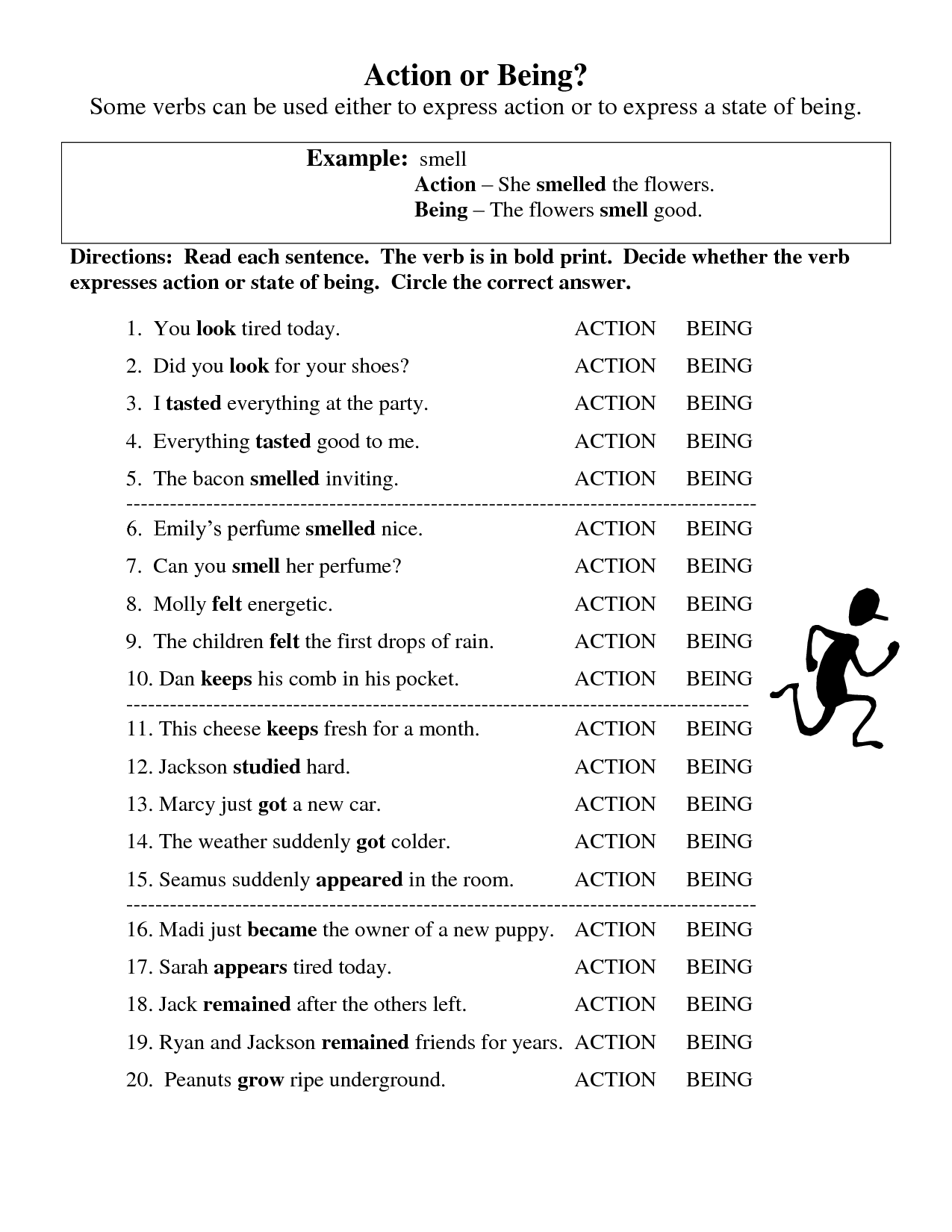
If the sentence still makes sense, it is a linking verb. If it isn't logical with the substitution, it's an action verb. State of being verbs can be used as linking verbs or action verbs. We need to be able to determine the function of the verb to tell the difference. The following sentences contain verbs that are used as either linking or action verbs.

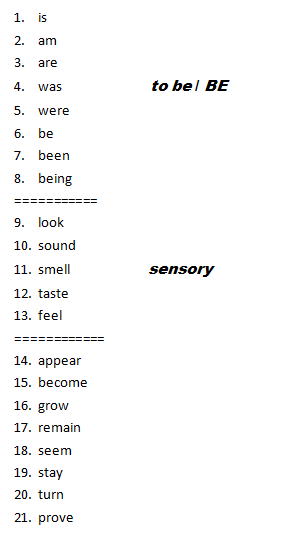
Any form of the verb be which includes am, it, is, are, were, was, has been, are being, etc. These verbs are called true linking verbs because they are always linking verbs. Then there are verbs that can be linking verbs or action verbs. They are used to link the subject of the sentence to the word that is describing it.

However, some linking verbs look like action words. Examples of linking verbs and action verbs are in the table below. The next time you write something, circle every linking verb you can find in the document. If you see many of them, you may want to rewrite some of the sentences and substitute some action verbs. Replacing just a few linking verbs with their more active counterparts can transform a page of writing.
There are other verbs that are sometimes linking verbs and sometimes action verbs. These include grow, prove, look, smell, sound, taste, turn, feel, remain, stay, and appear. The most common linking verbs are become, seem, and any form of the verb be (including am, is, are, was, were, etc.). Although there are a variety of auxiliary verbs in the English language, the following words are a few that often function as helping verbs. Note that these auxiliary verbs may function as action or linking verbs in other cases. Linking verb connects a descriptive noun or adjective to the subject, while an action verb describes the action being performed by the subject.
Do you ever get tired of all the busyness and action - like cooking, cleaning, working, writing, studying, carpooling, washing, mowing, driving, and typing? Do you ever wish you could get away from it all and just be - just exist calmly, without any action? Well, this lesson cannot give you that much-needed vacation from action. But it will introduce you to the type of verbs that do not express action. Linking verbs express a state of being and make a link in the sentence.
Before we talk more about that link, let's review the basic parts of a sentence. Linking verbs don't function in the same way as typical verbs in showing action, so it can sometimes be tricky to recognize them. When you write, you will naturally need to use both linking and action verbs; both verb types play a critical role in the English language. However, the overuse of linking verbs can sometimes leave a piece of writing flat. Where possible, don't just tell what something is; tell what it does. In each example, the subject is not "doing' the action.

When a linking verb works in this way, the subject complement will be an adjective or an adjective phrase. The subject complement can take a variety of different forms. Let's look at some sentences that use linking verbs to show what subject complements can look like. A linking verb connects the subject with a word that gives information about the subject, such as a condition or relationship. They do not show any action; but, they link the subject with the rest of the sentence.
For example, in the sentence "It is a risk," the word "is" is the linking verb that connects "it" and "risk" to show the relationship between the two words. This extremely useful fact gives us a simple way to distinguish linking verbs from action verbs. If a verb can take a predicate adjective as a complement, then it must be a linking verb. This relationship is completely absent in action verbs. According to traditional English grammar guides, a linking verb describes the subject by connecting it with the rest of a sentence. What's more, they can be a single word or a group of words.

Unlike other verbs, this type of verb does not convey action. Instead, they describe or identify a subject. Think of them as the glue that holds a sentence together. They do not describe the action, but always connect the subject to additional information.

The most common true linking verbs are forms of "to be," "to become" and "to seem." There are more examples below and suggestions about how to tell the difference between a linking verb and an action verb. The table below lists some verbs that are commonly used as linking verbs. Remember, the words in the list are not always used as linking verbs; it is the FUNCTION of the verb in the sentence that determines its kind. Instead, linking verbs express a state of being. Linking verbs are reserved for expressing a state of being.

Some verbs don't talk about actions, but instead link the subject to an adjective which gives us more information about the subject. Now's the time to practice what you have learned so far. See if you can identify which words in the following sentences are thesubject, thelinking verb, and what thesubject complementis. Check the end of the article for the answers. The following sentences all use linking verbs.
In order to tell if a verb is being used as a linking verb, look if the sentence has a subject complement. Remember, linking verbs are used to link information so there must be a subject complement that is describing or identifying a subject. Linking verbs operate differently than action verbs. First, while action verbs are modified by adverbs, linking verbs are often followed by adjectives. Some verbs don't express action but help complete statements about the subject by describing or identifying it.


No comments:
Post a Comment
Note: Only a member of this blog may post a comment.